
Hiring

Know how someonesells. Before youdecide who to hire.

Assess sales capability and coachability througha realistic, role-specific conversation - then carrywhat you learn into onboarding and continuouscoaching.

Candidates need only a link. No account, no download.

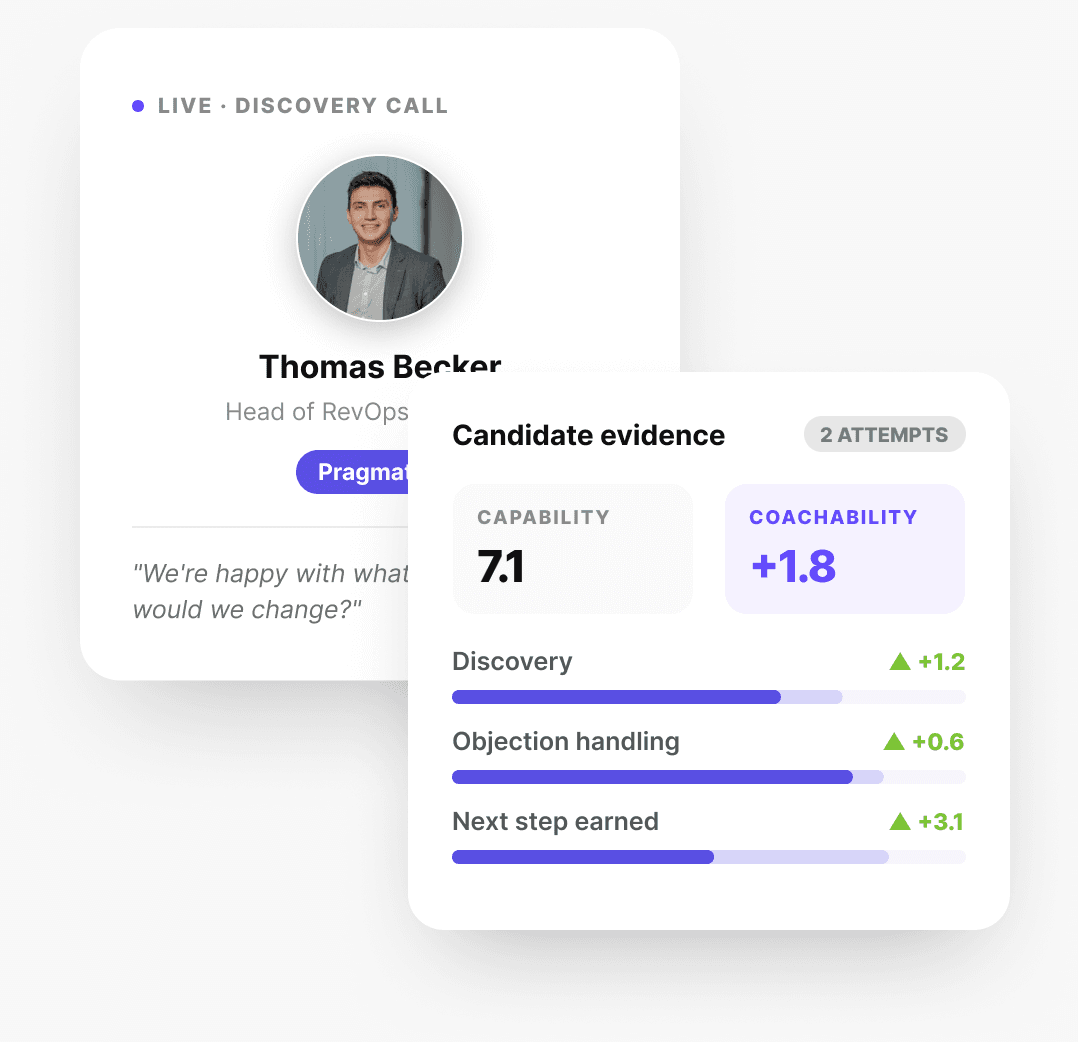
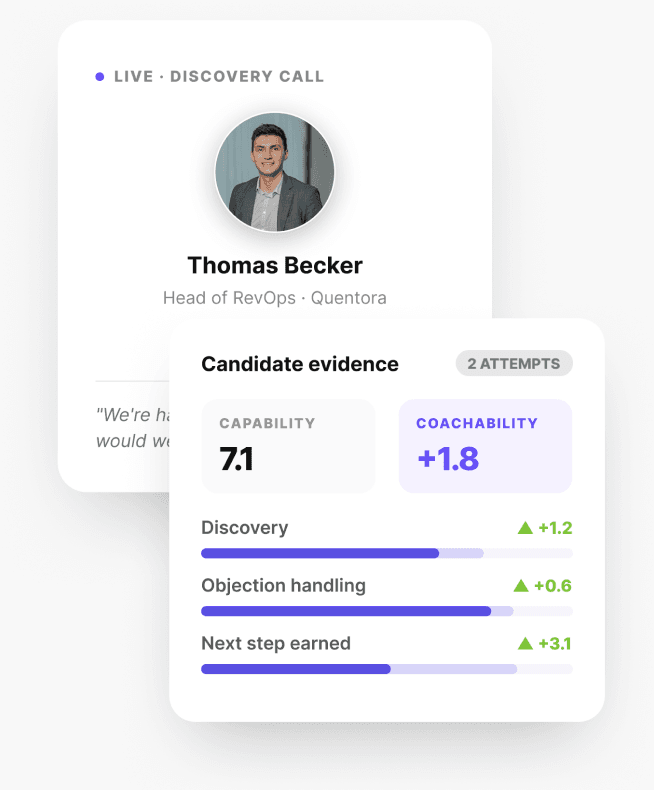
Illustrative exampleIllustrative exampleIllustrative example of candidate evidence from a discovery call with capability and coachability scores.
The problem

Assess the work, not only the interview.

CVs, interviews, references, and past attainment all carry useful information. But they describe selling - none of them show it happening.

What each source directly observes in a sales conversation.

Five behaviors that matter in the role.

  1. 1Runs discovery
  2. 2Handles pushback
  3. 3Communicates value
  4. 4Earns a next step
  5. 5Responds to coaching
Runs discoveryHandles pushbackCommunicates valueEarns a next stepResponds to coachingCovered

CV

A claim about past work

0 / 5

Interview

A prepared performance

0 / 5

Reference

A curated opinion

0 / 5

Attainment history

Someone else's territory, product, and market

0 / 5

A role-specific conversation

The work itself, observed

5 / 5
12345

CV

A claim about past work

0 / 5

Interview

A prepared performance

0 / 5

Reference

A curated opinion

0 / 5

Attainment history

Someone else's territory, product, and market

0 / 5

A role-specific conversation

The work itself, observed

5 / 5

Twenty cells, none observed - no score, no evidence, no moment to point at, because none of it happened in front of you.

Two signals

Capability today. Coachability in action.

Capability

How well does the candidate perform the work today?

Every candidate runs the same realistic, role-specific conversation. You see discovery, objection handling, value communication, and whether they earn the next step - under standardized conditions.

Illustrative example
Same conversation · same standard2 candidates
ACandidate A7.2
BCandidate B5.8
Role standard

Same brief, same buyer - the bar is the role's standard, not each other.

Coachability

What changes when they receive specific feedback and try again?

After the first attempt, the candidate receives one focused piece of coaching - and runs it again. The difference between attempts is measured, not guessed.

Illustrative example
One focused correction+1.8 measured
Attempt 16.4
Coaching
Attempt 28.2
Runs discovery6.47.6+1.2
Handles pushback7.88.4+0.6
Earns a next step5.18.2+3.1
How it works

Six stages. One standardfor every candidate.

Before the offer
01

Role & Standard

Define the role and the standard a strong hire must meet.

02

Simulated Buyer

Every candidate meets the same realistic buyer, built on your world.

03

Evidence

The conversation produces structured evidence, not impressions.

04

Feedback & Retry

One piece of coaching, one more attempt. Coachability, observed.

05

Human Decision

Your team reviews the evidence and makes the call.

06

Onboarding

What you learned becomes their first coaching priorities.

Before the offerAfter the offer
Built around the role

Not a generic sales test.

A strong enterprise AE and a strong outbound SDR do not pass thesame conversation. The assessment reflects the job someone isactually being hired to do - so the evidence means something.

Pick the role you're hiring for

Illustrative example

Pick the role you're hiring for

Illustrative example

Morgan Keane

VP Operations · logistics

SkepticalIncumbent in place
You're the third vendor to call this quarter. We've run the incumbent for six years and budget's frozen until Q3. Why would we change?
Scored againstMultithreading · quantified painBar: Build a case for change

Switch the role - the buyer, the pressure, and the scoring bar switch with it. The evidence structure underneath stays the same.

Morgan Keane

VP Operations · logistics

SkepticalIncumbent in place
You're the third vendor to call this quarter. We've run the incumbent for six years and budget's frozen until Q3. Why would we change?
Scored againstMultithreading · quantified painBar: Build a case for change
Same engine · your role

Switch the role - the buyer, the pressure, and the scoring bar switch with it. The evidence structure underneath stays the same for every candidate.

Candidate experience

An assessment that gives something back.

BriefSimulationFeedbackRetryUseful feedback
“Every candidate should leave with useful feedback - including the people you don't hire.

Pitstop sends every candidate specific, private feedback on their conversation - a reason to think well of your company, whatever the outcome.

The evidence package

What your hiring team receives

Before the final interview: structured evidence, side by side with the CV. Components, not a verdict.

Capability

Performance on the work

How the candidate ran discovery, handled objections, and communicated value - against the role's standard.

Coachability

Response to feedback

What changed between attempt one and attempt two after focused coaching.

Strengths

What they do well

The strongest observed behaviors, tied to moments in the conversation.

Development priorities

What to work on first

The specific gaps that would become early coaching priorities if hired.

Conversation evidence

Quotes and moments

Transcript excerpts behind every observation - evidence you can check, not a black box.

Human judgment

Questions for your interview

Areas that need a human read, with suggested follow-up questions for the final round.

Governance

Evidence supports the decision.
People make it.

01

Humans decide

Pitstop adds evidence to your hiring process. It does not automatically hire, reject, rank, or screen out anyone. Every decision is made by your team.

02

Same conversation,
standardized conditions.

Every candidate for a role gets the same brief, the same buyer, and the same standard - a documented, consistent basis for comparison.

03

Evidence you can inspect

Every observation links to a moment in the conversation. Your team can always see why the evidence says what it says.

After the offer

The assessmentdoesn't end at the offer.

HireDay OneOnboardPracticeCoachMeasure
Hire
Day One
Onboard
Practice
Coach
Measure

Most hiring assessments end when the offer goes out. With Pitstop, the strengths and gaps identified during hiring become the salesperson's first coaching priorities - waiting in their coaching plan on day one. No cold start, no honeymoon quarter, no rediscovering in month three what you already learned in the interview process.

Day-one coaching plan

Illustrative example
From hiring
  1. 1

    Quantify pain in discovery - strong rapport; push toward measurable business impact.

  2. 2

    Multithread earlier - tended to stay single-threaded with the champion.

  3. 3

    Keep doing: objection handling under pressure - improved sharply after coaching.

Pitstop assesses how a candidate actually sells in a realistic, role-specific conversation - including competencies such as discovery, active listening, communication, objection handling, commercial judgment and securing a next step.

Candidates can receive focused feedback and then repeat the role-play. This lets the hiring team see not only how someone performs initially, but whether they can understand feedback and change their behavior.

The assessment can become the starting point for onboarding and coaching. The strengths and development areas identified during hiring provide an evidence-based view of where the new hire should focus from day one.

No. Pitstop provides structured, evidence-linked assessment to support human judgment. The hiring decision remains with the employer.

TAKE A PITSTOP

Start continuous
coaching before Day One.
Start continuous coaching before
Day One.

See how someone sells - and how they improve when coached - before you hire them.

For the full business case, read our Sales Hiring white paperRead the Sales Hiring white paper