

CV history, recruiter interviews, manager interviews, competency interviews, presentations, references.
THE SALES HIRING GAPThe problem starts
The problem starts
before Day One.
Sales hiring has an evidence problem. CVs show what someone has done. Interviews show how well they can explain it. References add another opinion. None of them show how someone actually sells - or what happens when they are coached.
Pitstop white paper
The Case for Evidence Based
Sales Hiring
The evidence gap, the commercial cost of a poor hire, and an illustrative exposure model.
Request the White PaperThe Sales Hiring Gap is the distance between the evidence a traditional hiring process produces and the evidence a sales hiring decision actually needs: how the person sells, and whether they improve when coached.
WHAT YOU SEE VS WHAT YOU NEED
Assess more of the work itself.
Discovery, listening, commercial judgement, qualification, objection handling, adaptability, and the ability to progress a buyer conversation.
Some companies add practical exercises late in the process, usually only for a few finalists, because running them manually takes significant employee time.
An excellent interviewer is not necessarily an excellent salesperson. The reverse can also be true.
Most hiring processes ask whether someone is coachable. It is now possible to observe it.
The assessment should begin with the work. The role defines what good looks like. An SDR, an account executive and an enterprise seller require different behaviors and different performance standards. A useful assessment therefore begins with the role, the buyer, the required behaviors and the performance bar.
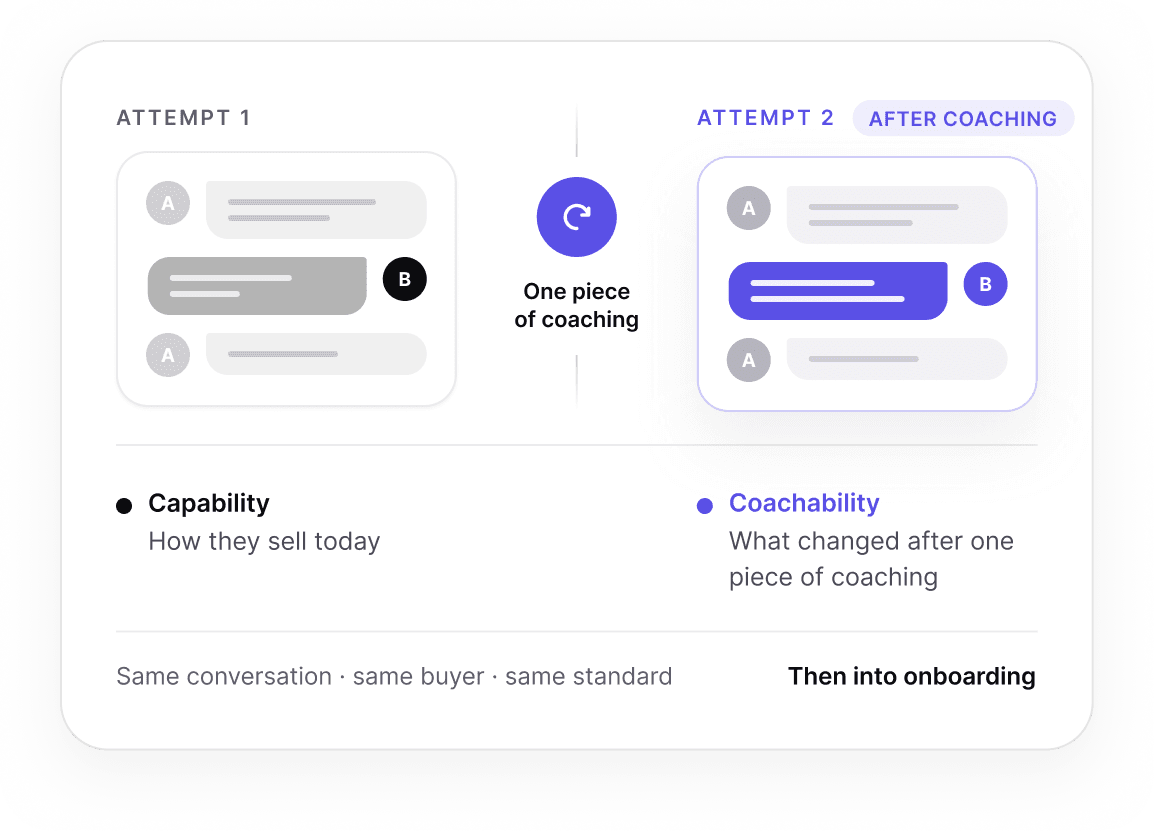
When shown something specific to improve, can this person apply the feedback? One meaningful moment is identified, one focused piece of coaching is provided, and the candidate retries that moment.
Capability vs coachability
Capability tells you what they can do today. Coachability shows what changes when someone shows them how.
The commercial cost
The downside extends far beyond recruitment.
A poor sales hire is not simply a recruitment cost. It is a commercial risk.
Lost sales capacity
A territory, leads, and a revenue target sit with someone who is not yet performing at the required level.
Compensation during underperformance
Employment cost is committed while the organization is still discovering whether the person can perform.
Management capacity
Underperforming hires need disproportionate call review, coaching, deal support, and repeated intervention.
Starting again
If the hire fails, the organization sources, interviews, assesses, and ramps a replacement while the commercial position stays exposed.
A practical model for estimating exposure.
Not artificial precision - just the scale of commercial capacity attached to one sales hiring decision.
Illustrative exposure model
$750,000
Nine months of a $1M annual quota
$375,000
Illustrative 50% attainment
$375,000
Versus prorated quota
Apply the model to your own numbers in the white paper
Why should companies wait until after someone
is hired to see meaningful evidence
of how they sell?
The Case for Evidence Based Sales Hiring · Pitstop white paper
Assess 100 candidates. Don't schedule 100 role-plays.
The assessment should begin with the work. The role defines what good looks like. An SDR, an account executive and an enterprise seller require different behaviors and different performance standards. A useful assessment therefore begins with the role, the buyer, the required behaviors and the performance bar.
When shown something specific to improve, can this person apply the feedback? One meaningful moment is identified, one focused piece of coaching is provided, and the candidate retries that moment.
The Hidden Trade Off
The company uses weaker evidence to decide who gets access to its strongest evidence.
The organization cannot realistically give every credible candidate a meaningful live role-play with senior employees. So the problem is not only about saving time. It is about assessment coverage.
Illustrative assessment modelManual practical assessment Human time avoided
200 hours
100 candidates, 1 hour, 2 employees
155 hours
Illustrative AI assessment model
Be precise about what one simulation can prove.
Credibility requires limits. A structured sales conversation is direct evidence of some things and no evidence at all of others.
01
A simulation can provide useful evidence on
Observed directly in the conversation itself.
 Discovery
- Commercial awareness
- Active listening
- Qualification
- Objection handling
- Communication
- Resilience and adaptability
- Securing a next step
02
Evidence may need to come from elsewhere
Interviews, references and time on the job still carry these.
 Long term work ethic
- Collaboration
- Time management
- Internal stakeholder management
- Sustained quota performance
- Broader technical capability
Where Pitstop fits
See how Pitstop closes the Sales Hiring Gap.
Pitstop puts every candidate in the same realistic, role-specific sales conversation, gives them one piece of coaching, and asks them to go again - so your team sees capability and coachability before the offer, then carries what it learned into onboarding.

Pitstop white paper
The Case for Evidence Based Sales Hiring
PDF · Illustrative exposure model · 16 pages
Know how someone sells before you decide who to hire.
The paper moves from the evidence gap to the commercial consequence, then shows how practical assessment can scale without consuming hundreds of employee hours.
Designed for sales and people leaders - CROs, VPs of Sales, Heads of Talent, Talent Acquisition leaders and Chief People Officers.
The white paper includes:
- The sales hiring evidence gap
- The commercial cost of a poor hire and an illustrative exposure model
- How AI changes the economics of practical assessment
- Assessing capability, then observing coachability
- What one simulation can and cannot prove
- Methodology and assumptions
PDF · Illustrative exposure model · 16 pages
 TAKE A PITSTOP